A concrete finisher is the tradesperson who levels, smooths, and textures freshly placed concrete so the surface meets the grade, flatness, and finish the job calls for. Floors, sidewalks, slabs, foundations, curbs, and walls all pass through a finisher’s hands between the time the truck arrives and the time the concrete hardens.
The work is physical, outdoors, and on a clock set by the concrete itself. It’s also a trade you can start with little or no experience, learn on the job, and build into a long career. This guide covers what a concrete finisher does day to day, the tools and skills involved, the safety rules that apply, and the steps to get started.
Concrete Finisher at a Glance
- What the job is: placing, leveling, floating, troweling, and curing concrete so the finished surface meets the specification.
- Also called: cement mason. The federal government counts the two together as “cement masons and concrete finishers.”
- Where the work happens: industrial floors, warehouses, foundations, sidewalks and curbs, parking areas, bridges, and utility pads.
- How people start: as a concrete laborer or helper, through a registered apprenticeship, or both. A high school diploma or equivalent is common but not always required.
- What helps you advance: reliable attendance, a feel for timing, an OSHA 10 card, and industry certifications such as those from the American Concrete Institute.
Table of Contents

What Is a Concrete Finisher?
A concrete finisher works fresh concrete into its final shape and surface. Concrete arrives as a heavy, wet mix. In a window of a few hours it stiffens and sets, and whatever the surface looks like at that point is what the owner lives with for decades. The finisher’s job is to use that window well.
That means striking the concrete off to the right height, pushing down the coarse stone, bringing up enough paste to close the surface, cutting edges and joints, and giving the surface the texture it needs. A warehouse floor gets a hard, dense steel-trowel finish. A sidewalk gets a broom finish for traction. A wall gets patched and rubbed after the forms come off.
Concrete finisher vs. cement mason
The two titles describe the same trade. “Cement mason” is the traditional name and is still used by unions, apprenticeship programs, and the U.S. Bureau of Labor Statistics. “Concrete finisher” is what most contractors put on a job posting. Some companies use “finisher” for the most skilled hands on the crew and “laborer” for people placing and spreading concrete, while others use the titles loosely.
Is a concrete finisher the same as a concrete laborer?
Not quite. A concrete laborer helps set forms, places and spreads concrete, handles materials, and keeps the site clean. A concrete finisher focuses on the surface: floating, troweling, edging, and curing. On most crews the jobs overlap, and laborers who show they can read concrete move into finishing. Doss and Horky’s Concrete Laborer posting describes exactly that mix: setting forms, placing rebar and wire mesh, pouring, and finishing with trowels and floats.
What Does a Concrete Finisher Do on a Typical Pour?
Every pour follows roughly the same sequence. The order matters because concrete doesn’t wait.
Before the concrete arrives
The crew checks forms for line, grade, and bracing, and confirms reinforcement sits on its supports at the right height. Embeds, anchor bolts, and blockouts get one last look. Tools are laid out, power trowels are fueled, and curing materials are staged. If rain, heat, or cold is coming, protection is ready before the first truck shows up.
Placing and consolidating
Concrete comes off the truck by chute, buggy, or pump. Laborers and finishers spread it with rakes and come-alongs, moving it into place without dragging it so far that the mix separates. A vibrator consolidates the concrete so it fills around rebar and into corners without leaving voids.
Screeding
Screeding strikes the concrete off to its finished height. On small pours that’s a straight board or a magnesium screed pulled across the forms. On large industrial floors, a laser-guided screed machine does it with far more accuracy. The slab on grade guide explains why flatness matters so much on those floors.
Bull floating
Right after screeding, a finisher pushes a wide, long-handled float across the surface. Bull floating knocks down high spots, fills low ones, and embeds the coarse aggregate just below the surface.
Waiting for bleed water
As concrete settles, water rises to the surface. This is bleed water, and experienced finishers wait for it to evaporate before working the surface again. American Concrete Institute guidance warns against finishing while bleed water is present, because working it back into the top layer weakens the surface and invites dusting, scaling, and cracking. Knowing when to wait and when to move is the most important skill a concrete finisher has.
Edging and jointing
Edgers round the slab’s edges so they resist chipping. Groovers cut control joints into fresh concrete on sidewalks and smaller slabs. On larger floors, joints are saw-cut later the same day.
Floating and troweling
Once the surface can hold a finisher’s weight with only a light footprint, the crew floats it to close the surface, then trowels it to make it dense and smooth. Hand floats and trowels handle edges and small areas. Walk-behind power trowels and ride-on trowels finish large floors, starting with float pans and moving to steel blades as the concrete stiffens. Each pass happens at a steeper blade angle.
Applying the final texture
Interior floors usually stop at a hard steel-trowel finish. Exterior walks, ramps, and drives get a broom drawn across them to leave ridges for traction. Decorative work may be stamped, colored, or washed to expose the aggregate.
Curing and cutting
Concrete needs moisture and moderate temperatures to gain strength. Finishers spray a curing compound or cover the slab with wet curing blankets or plastic. Saw crews cut control joints as soon as the concrete is hard enough that the blade won’t ravel the edges, often within hours on large floors.
Concrete Finishing Tools Every Finisher Learns
| Tool | What it does |
|---|---|
| Screed (board, magnesium, or laser screed) | Strikes concrete off to finished height |
| Bull float and darby | Levels the surface and embeds aggregate after screeding |
| Magnesium and wood hand floats | Open and close the surface, work edges and small areas |
| Steel hand trowels and fresno | Produce a smooth, dense finish by hand or on a long handle |
| Edgers and groovers | Round edges and cut joints in fresh concrete |
| Walk-behind and ride-on power trowels | Float and trowel large floors |
| Concrete vibrator | Consolidates concrete and removes trapped air |
| Kneeboards | Spread a finisher’s weight on fresh concrete |
| Brooms | Leave a slip-resistant texture on exterior surfaces |
| Early-entry and walk-behind saws | Cut control joints after the concrete stiffens |
| Curing sprayer and blankets | Hold moisture in the slab while it gains strength |
New finishers usually start on hand tools and work up to power trowels once a lead finisher trusts their timing. Many contractors supply the larger equipment. Some expect finishers to bring their own hand tools; ask before your first day.
Skills That Make a Good Concrete Finisher
Timing. Concrete sets faster on hot, windy days and slower in the cold. A good concrete finisher reads the surface by touch and eye, not by the clock, and knows when the slab is ready for the next pass.
Stamina. The work involves kneeling, bending, lifting, and long days. Doss and Horky’s concrete posting asks for the ability to lift and carry 50 pounds or more and to kneel and squat for long periods.
Attention to detail. Specifications set elevations, flatness, joint spacing, and finish type. Small misses become expensive repairs once concrete hardens.
Teamwork. A pour is a coordinated push. Finishers work closely with laborers, carpenters, pump operators, and the superintendent, and they cover for each other when one area sets faster than another.
Plan reading. Finishers who can read drawings, find elevations, and understand joint layouts become lead finishers and foremen.
Weather sense. Kentucky pours face summer heat and humidity and winter cold. Finishers learn to plan around both, using early starts in summer and heated enclosures and blankets in winter.
Concrete Finisher Safety: The Hazards and the Rules
Concrete finishing carries real hazards. Most of them are well understood and controlled with training, the right gear, and planning.
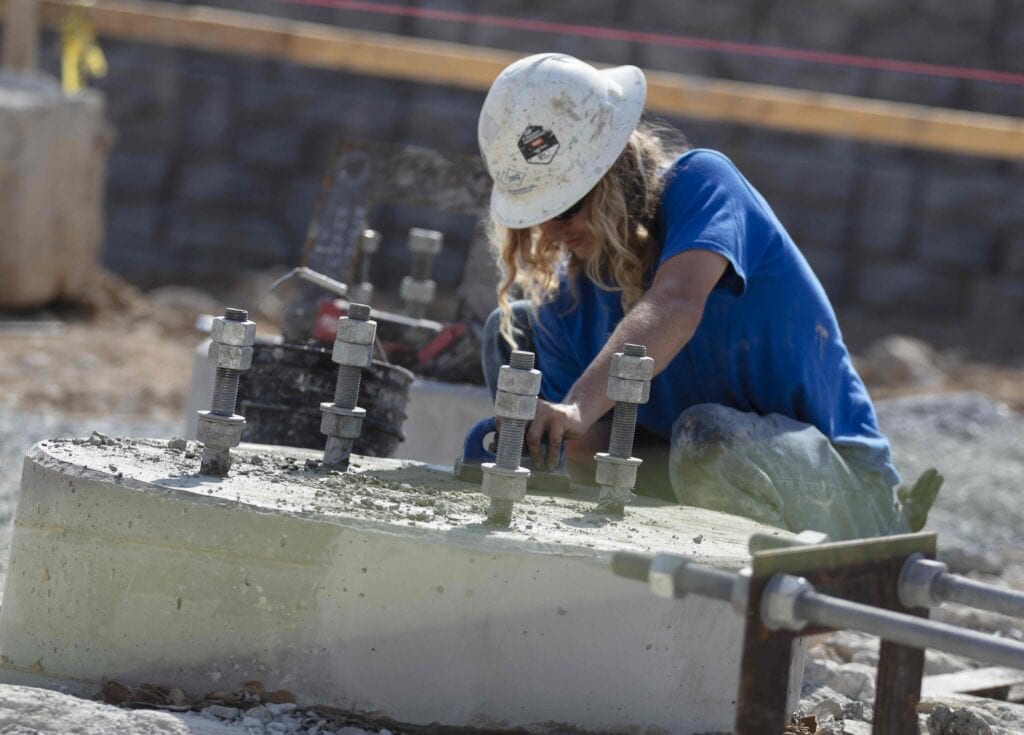
Cement burns
Wet concrete is strongly alkaline. Long contact with skin can cause chemical burns that may not hurt until the damage is done, and concrete that soaks through clothing or gets inside boots is a common cause. Finishers wear waterproof gloves, rubber boots, long sleeves, and eye protection, and they wash exposed skin promptly with clean water.
Silica dust
Cutting, grinding, and chipping hardened concrete releases respirable crystalline silica. OSHA’s construction silica rule, 29 CFR 1926.1153, sets a permissible exposure limit of 50 micrograms per cubic meter of air over an 8-hour day. Its Table 1 lists accepted controls for common tasks, such as using water on walk-behind saws and handheld grinders.
Power trowels
Power trowels spin heavy blades fast. Under 29 CFR 1926.702, manually guided powered trowels must shut off automatically when the operator’s hands leave the handles. Finishers learn to inspect that control before every use.
Protruding rebar
Exposed rebar ends are an impalement hazard. 29 CFR 1926.701 requires protruding reinforcing steel that workers could fall onto or into to be guarded, usually with rebar caps or covers.
Strain, heat, and cold
Knee and back strain are the long-term hazards of the trade. Kneeboards, knee pads, rotating tasks, and lifting with help reduce them. Heat illness is a summer risk, and cold stress a winter one. Water, shade, rest breaks, and layered clothing are part of every pour plan.
An OSHA 10 card is a common starting credential for new finishers. Our guide to OSHA 10 vs. OSHA 30 explains what each card covers and who usually needs which.
How to Become a Concrete Finisher in 5 Steps
1. Start as a concrete laborer or helper
Most concrete finishers started by carrying tools, raking concrete, and cleaning up. Many contractors hire laborers without experience and train them on the job. Doss and Horky’s concrete laborer posting, for example, lists previous experience as preferred but not required and notes that on-the-job training is often provided.
2. Get basic safety training
An OSHA 10-Hour Construction card shows an employer you know the major site hazards. Some employers pay for it after you’re hired. Steel-toe boots, a willingness to wear PPE every day, and a valid driver’s license help too.
3. Learn under an experienced finisher
The trade is learned with your hands. Ask to run a float, edge a slab, or follow a lead finisher on the power trowel. Pay attention to how they test the surface and decide when to make the next pass. Most finishers say the first full year teaches more than any class.
4. Consider a registered apprenticeship
Registered apprenticeships pair paid work hours with classroom instruction and end with a nationally recognized credential. Cement mason apprenticeships are offered through union programs and some contractor associations. Program length and pay steps vary, so compare programs in your area.
5. Earn an industry certification
Certifications aren’t required by law for most finishing work, but some project specifications call for certified finishers, and they help on a resume. The American Concrete Institute’s certification programs include Concrete Flatwork Associate, Concrete Flatwork Finisher, Advanced Concrete Flatwork Finisher, and a Specialty Commercial/Industrial Concrete Flatwork Finisher credential aimed at industrial floors.
Concrete Finisher Pay and Career Path
Concrete finisher pay depends on region, experience, the type of work, and whether the job is union or covered by a wage requirement. Commercial and industrial flatwork often pays more than residential work because the specifications are tighter and the floors are larger.
The trade also has a clear ladder:
- Laborer or helper: placing concrete, handling materials, learning tools.
- Concrete finisher: floating, troweling, edging, and curing on your own.
- Lead finisher: running the finishing crew on a pour and making timing calls.
- Foreman: planning pours, coordinating trucks and pumps, and managing the crew.
- Superintendent: running the whole site, schedule, and safety program.
Finishers who learn to read plans, understand specifications, and keep a safe crew are the people companies promote. Some move into estimating or project management later.
What a Day Looks Like on a Commercial Concrete Crew
Concrete days start early. Crews often arrive before sunrise in summer so the pour finishes before the hottest part of the day. The morning is placement and screeding. Midday is floating and troweling as the slab stiffens. Afternoon brings saw cutting, curing, and cleanup. On big floor pours, part of the crew may stay into the evening to finish the last section.
Between pours, finishers set forms, tie or place reinforcement, strip forms, patch walls, and prepare the next area. Weather changes the plan. Rain can stop a pour, and freezing nights mean blankets and heaters.
The payoff is visible. A finished floor, foundation, or sidewalk is something you can point to years later and say you built.
Working as a Concrete Finisher at Doss and Horky
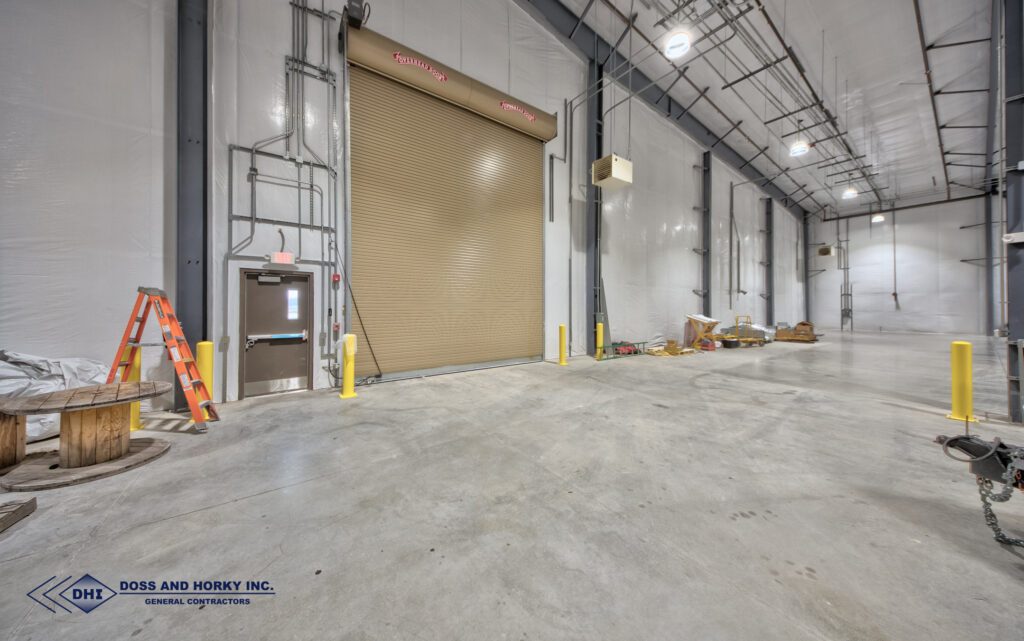
Doss and Horky started in bridge and concrete construction in Danville in 1985, and concrete is still at the center of the company’s work. The team handles formwork, pumping, placement, finishing, and foundations in-house across industrial, commercial, utility, and distillery projects, from warehouse floors like those in our slab on grade guide to substation foundations.
DHI frequently hires for concrete roles. The careers page describes a safety-first, family-oriented team that invests in training and advancement and offers competitive wages and benefits.
Concrete Finisher FAQ
What is a concrete finisher?
A concrete finisher is a tradesperson who levels, smooths, and textures freshly placed concrete. They screed, float, trowel, edge, and cure concrete so floors, slabs, sidewalks, and foundations meet the grade, flatness, and finish in the specification.
What do concrete finishers do every day?
On pour days they place and consolidate concrete, screed it to height, bull float it, wait for bleed water to leave, then edge, float, trowel, texture, and cure the surface. Between pours they set and strip forms, place reinforcement, patch walls, and prepare the next area.
Is a cement mason the same as a concrete finisher?
Yes. The titles describe the same trade. “Cement mason” is the older term used by unions, apprenticeship programs, and the Bureau of Labor Statistics. “Concrete finisher” is the title most contractors use on job postings.
Do you need experience to become a concrete finisher?
Usually not to start. Many contractors hire concrete laborers or helpers without experience and train them on the job. Finishing skill comes with time spent working under an experienced finisher.
Do concrete finishers need a certification?
No law requires one for most finishing work. Some projects specify certified finishers, and certifications such as the American Concrete Institute’s Concrete Flatwork Finisher credential help with hiring and advancement. An OSHA 10 card is a common entry-level safety credential.
How long does it take to become a concrete finisher?
It varies with the person and the amount of work. Most people need at least a year or two of steady pours to finish on their own, and longer to lead a crew. Registered apprenticeships typically run several years and combine work hours with classroom instruction.
When do you broom finish concrete?
After the surface has been floated and, if specified, troweled, and while it’s still soft enough to take texture. Brooming too early tears the surface. Brooming too late leaves faint marks. Exterior walks, ramps, and drives usually get a broom finish for traction.
Is concrete finishing hard work?
Yes. It’s physically demanding, often done outdoors in heat or cold, and involves kneeling, lifting, and long days on pour schedules. It’s also steady, skilled work with a clear path to lead finisher, foreman, and superintendent roles.
Build Your Career With Doss and Horky
If you’re ready to learn the trade or bring your experience to a Kentucky crew, see Doss and Horky’s open positions on the careers page or apply directly for the Concrete Laborer role. Owners and project teams can learn about our concrete and building work through the General Contracting Division. Questions? Call 859-236-2690.