Substation construction is the work of building the facility where a utility changes voltage, switches circuits, and protects its lines. It covers everything from clearing and grading the site to setting transformers, wiring the control house, testing every device, and finally energizing the station.
A substation looks simple from the road: a fenced yard of steel and gravel. Under and inside that fence are a grounding grid, dozens of foundations, conduit and cable runs, and protection systems that all have to be built in the right order. This guide walks through substation construction from a bare greenfield site to the day the station carries load, and explains what owners, utility engineers, and project managers should plan for along the way.
Substation Construction at a Glance
- What it is: building a facility that steps voltage up or down, switches circuits, and protects transmission and distribution lines.
- Main phases: planning and permits, site work, below-grade work, above-grade work, control and wiring, testing and commissioning, energization.
- What sets the schedule: permits, long-lead equipment such as power transformers, and the utility’s outage windows for tie-in.
- Key standards: the utility’s own design standards, the National Electrical Safety Code (NESC), IEEE Std 80 for grounding, and OSHA’s rules for electric power work in 29 CFR 1926 Subpart V.
- What finishes it: testing and commissioning, then energization under the utility’s switching procedures.
Table of Contents
What Is Substation Construction?
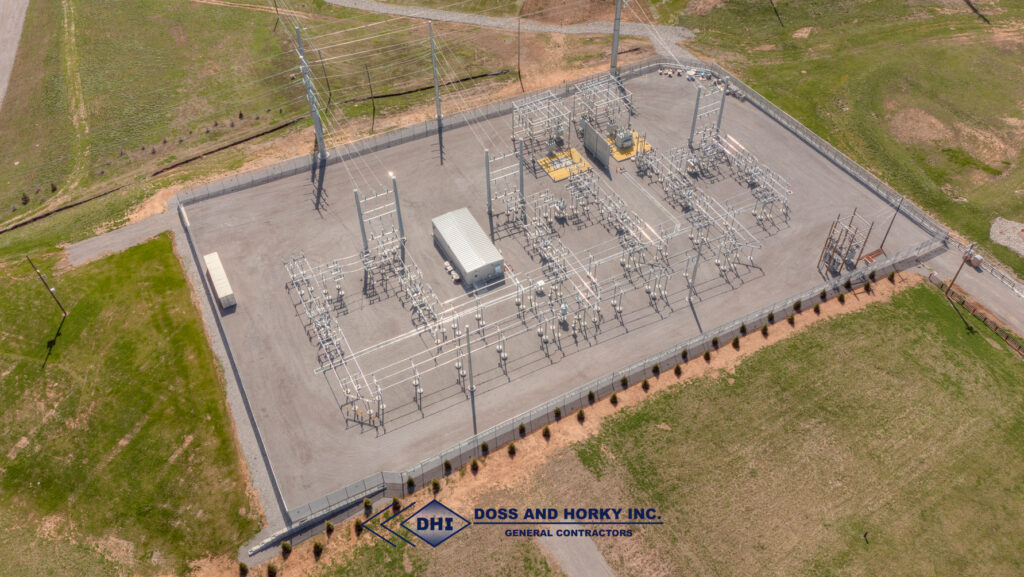
Substation construction is the civil, structural, and electrical work that turns an engineered design into a working substation. It usually splits into two scopes. The civil scope covers site work, the grounding grid, foundations, conduit, drainage, the yard surface, and the fence. The electrical or “physical” scope covers steel structures, bus, equipment, the control house, wiring, and testing. Some projects award both to one contractor; others split them.
Substations come in a few common types, and the type shapes the work:
- Transmission substations connect high-voltage transmission lines and often step voltage up or down between transmission levels.
- Distribution substations step transmission voltage down to distribution voltage for the lines that feed homes and businesses.
- Switching stations connect and isolate lines without changing voltage.
- Customer or industrial substations serve one large user, such as a manufacturing plant or data center.
- Collector substations gather power from a wind or solar project and step it up to transmission voltage.
A greenfield substation is built on a site with no existing station. An expansion or rebuild happens next to, or inside, an energized station. Greenfield substation construction gives the crew open space to work. Expansion work has to be planned around live equipment and outage windows, which changes the sequence and the safety plan.
Who Is Involved in Substation Construction
Substation construction brings together several parties, and knowing who owns which decision prevents delays.
- The owner, usually a utility or a large industrial customer, sets standards, buys major equipment, and schedules outages.
- The engineer of record designs the station: layout, grounding, foundations, protection and control, and the drawing set.
- The civil contractor builds the site, grounding, foundations, conduit, and yard.
- The electrical contractor erects steel, sets equipment, installs bus, and wires the station.
- Testing and commissioning technicians test equipment and protection systems before energization.
- Equipment manufacturers supply transformers, breakers, switches, and relay panels, and often send field service staff.
Owners often buy the major equipment directly because it takes the longest to arrive. Power transformers are custom-built, and lead times for large units have stretched past a year in recent years. That one item can set the whole substation construction schedule, so it’s ordered as early as the design allows.
Substation Construction Step by Step
The details come from the drawings and the utility’s standards, but most substation construction follows the same 12 steps.
1. Planning, siting, and permits
Before any equipment arrives, the owner picks a site, studies the system need, and starts design. Permits commonly include zoning or land-use approval, construction stormwater coverage, and, where streams or wetlands are involved, Clean Water Act permits. Sites that disturb an acre or more usually need construction stormwater coverage, described on the EPA’s construction stormwater page. Transmission line routing, easements, and road access get settled during this phase too.
2. Geotechnical investigation and survey
Soil borings tell the engineer how much load the ground can carry, where rock and groundwater sit, and how the soil conducts electricity. That last point matters for grounding design. A topographic survey maps the existing grades and features so the design can balance cut and fill.
3. Site clearing, erosion control, and access
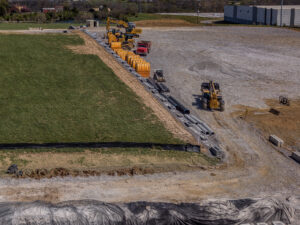
Crews clear the footprint, install silt fence and other erosion controls, and build a construction entrance. Access roads need to carry heavy cranes and the transformer delivery, so their alignment, turning radii, and base thickness come from the engineer’s design. Our guide to site preparation for substations covers this early ground work in detail.
4. Grading and the substation pad
The site is graded to the design elevations, with fill placed in compacted lifts and tested. The pad is shaped so water drains away from equipment and out of the yard. Getting the pad elevation and drainage right is one of the most important steps in substation construction, because standing water undermines foundations and stone surfacing.
5. Grounding grid
The grounding grid is a mesh of bare copper conductors buried across the yard, usually extending past the fence. Every structure, piece of equipment, and the fence itself connect to it. During a fault, the grid carries current safely into the earth and keeps step and touch voltages low enough to protect people standing in or near the station. IEEE Std 80, the IEEE Guide for Safety in AC Substation Grounding, is the standard most engineers use to design it. Ground rods, exothermic welds or compression connections, and test points are installed to the drawings, and grid resistance is often measured before backfill.
6. Foundations
Substation construction uses several foundation types:
- Drilled piers for steel structures, switches, and dead-end towers that resist wind, ice, and line tension.
- Mat or slab foundations for transformers, breakers, and the control house.
- Oil containment around oil-filled transformers, so a leak or rupture doesn’t reach soil or water.
Anchor bolts are set to tight tolerances, because steel and equipment bases have to fit them exactly. Concrete is tested to the specification. Oil containment ties into the owner’s spill planning; EPA’s oil spill prevention regulations (the SPCC rule in 40 CFR 112) apply to many facilities that store oil, including oil-filled electrical equipment above certain quantities.
7. Below-grade conduit, duct banks, and cable trench
Conduits connect each device in the yard to the control house. They run in concrete-encased duct banks, direct-buried conduit, or precast cable trench, depending on the design. Drainage pipes, storm structures, and any water or sewer service for the control house go in at the same stage. All of it has to be coordinated with the grounding grid and foundations so nothing collides. Our guide to underground utility construction explains trench methods, testing, and safety.
8. Steel structures and bus
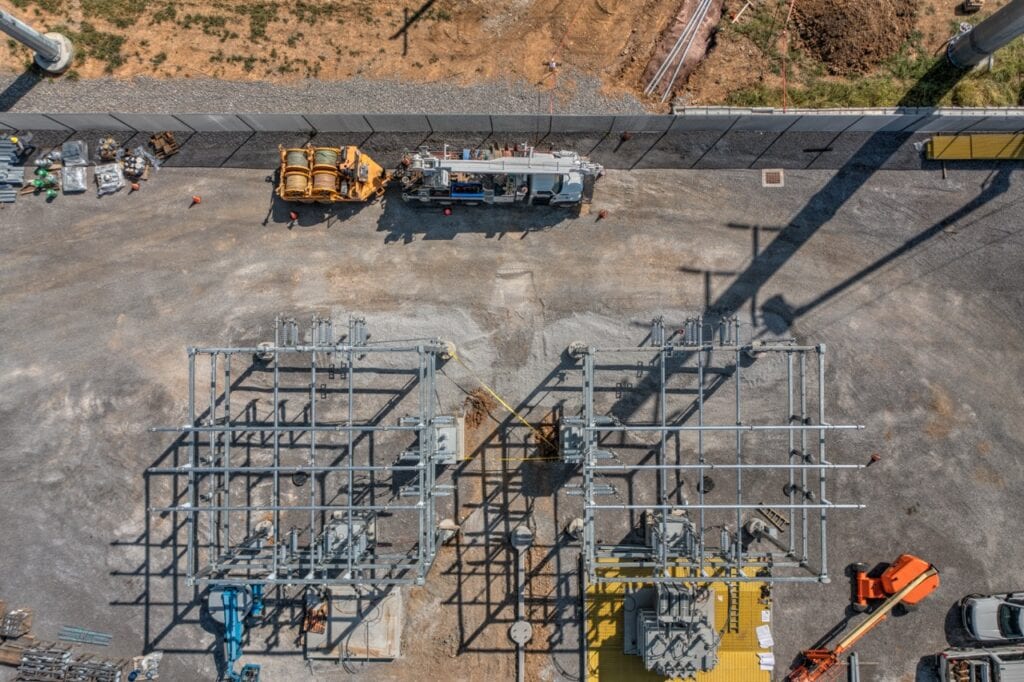
Once foundations cure, crews erect the steel: dead-end structures where lines enter the station, bus supports, switch stands, and equipment stands. Rigid bus (aluminum tube) or strain bus (cable) is then installed to connect the equipment. Steel goes up plumb and to elevation, because bus alignment depends on it.
9. Setting major equipment
Transformers, circuit breakers, disconnect switches, instrument transformers, surge arresters, and capacitor banks are set on their foundations. A power transformer often arrives by heavy-haul truck and is set by crane or jacked and skidded into place. It’s then assembled, filled with oil under vacuum, and tested, often with the manufacturer’s field technician on site.
10. Control house, cable pulling, and wiring
The control house holds protective relays, metering, communications, batteries, and AC and DC panels. Some are built on site; many arrive as prefabricated enclosures. Control cables are pulled from each device through the conduit system to the control house, then terminated and labeled. Cable pulling has to respect the cable’s pulling tension and bend radius limits, and every conductor gets checked against the wiring diagrams.
11. Yard stone, fence, and final civil work
The yard is covered with crushed stone. Stone surfacing improves drainage, controls weeds, and adds a high-resistance layer that helps protect people from step and touch voltage. The perimeter fence goes up and is bonded to the grounding grid. OSHA’s substation rule, 29 CFR 1926.966, requires conductive substation fences to be grounded. Gates, signage, lighting, and permanent stabilization of the surrounding slopes finish the civil work.
12. Testing, commissioning, and energization
Testing proves the station works before it carries power. Typical tests include insulation resistance, transformer turns ratio and power factor, breaker timing, contact resistance, relay settings and trip checks, and point-to-point wiring checks. Commissioning then tests the whole protection scheme as a system.
Energization is the last step of substation construction. The utility’s operators follow a written switching plan to bring the station on line in stages, with crews clear of the yard and the equipment monitored as voltage is applied. Once the station carries load and the owner accepts it, the as-built drawings, test reports, and equipment manuals are turned over.
Safety in Substation Construction
Substation construction combines the hazards of heavy civil work with the hazards of high voltage. Several OSHA rules apply at once.
- Electric power work. OSHA’s 29 CFR 1926 Subpart V covers the construction of electric power transmission and distribution lines and equipment, starting with 29 CFR 1926.950. It covers qualified workers, minimum approach distances, de-energizing, and grounding.
- Protective grounding. 29 CFR 1926.962 requires lines and equipment worked as de-energized to be properly grounded to protect workers.
- Work in substations. 29 CFR 1926.966 requires access and working space around equipment, grounded fences, and guarding of energized parts. It also covers fence expansions, where sections must be isolated, grounded, or bonded as needed.
- Excavation. Grounding grid, foundation, and duct bank trenches fall under the excavation rules in 29 CFR 1926.651 and 1926.652.
- Cranes and rigging. Setting steel and transformers involves heavy picks, often near energized lines on expansion projects.
Expansion work inside an energized substation carries the most risk. The utility controls the switching and clearances, and the contractor’s crews work inside defined boundaries. Clear communication between the utility’s operators and the field crew belongs in the written safety plan.

How Long Does Substation Construction Take?
There’s no standard duration. A small distribution substation on an open site moves much faster than a large transmission substation or an expansion inside a live station. The main factors are:
- Permits and land rights, which can take longer than construction itself.
- Equipment lead times, especially power transformers and breakers.
- Site conditions, such as rock, poor soil, or a large grading job.
- Outage windows. Utilities often limit when existing lines can be taken out of service, which sets tie-in dates.
- Phasing. Multi-phase projects build part of the station, energize it, and then continue.
- Weather, which affects grading, concrete, and stone placement.
What Drives the Cost of Substation Construction
Substation construction costs vary too widely between projects for a per-station number to be useful. Voltage class, the number of bays, the transformer size, and the site all move the total. The biggest drivers are:
- Major equipment. Transformers and breakers are usually the largest line items.
- Voltage and layout. Higher voltage means larger clearances, bigger structures, and a bigger yard.
- Site work. Clearing, rock excavation, imported fill, and long access roads add up.
- Grounding. Poor soil conductivity can require a larger grid or deeper rods.
- Foundations. Rock, groundwater, or weak soils change pier depths and methods.
- Greenfield or expansion. Working inside an energized station adds time for switching, clearances, and protection.
- Line work. Bringing transmission and distribution lines into the station is often a separate cost.
What Owners Should Plan For
Most delays in substation construction trace back to a few early decisions:
- Order long-lead equipment early, and confirm delivery routes for the transformer before the access road is designed.
- Get geotechnical data before design is final, including soil resistivity for the grounding design.
- Plan outages with the system operator well ahead of tie-in.
- Define the scope split between civil, electrical, and testing contractors so nothing falls between them.
- Leave room for growth. Spare conduit, space for future bays, and a pad sized for the next transformer cost little now and save a second mobilization later.
- Set the turnover package up front: as-builts, test reports, relay settings, and manuals in the format the operations team uses.
Substation Construction at Doss and Horky
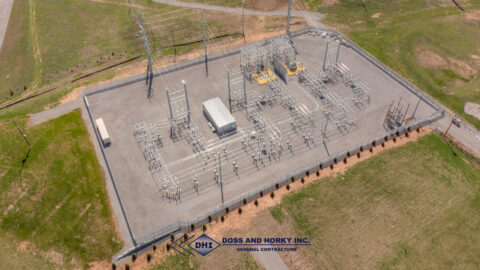
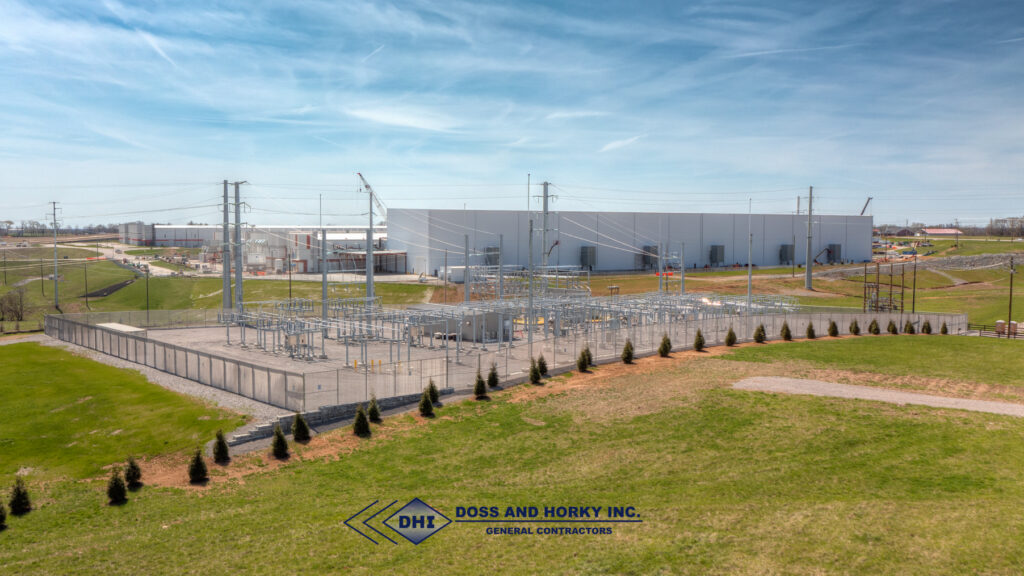
Doss and Horky’s Utility Division builds substations for Kentucky utilities. On the LG&E-KU Shelbyville substation, the team started from a greenfield site on a multi-phase project. The Utility Division’s substation work includes civil site development, concrete foundations, below-grade, above-grade, and underground duct banks, and pulling cable to prepare substations for energization.
Substation Construction FAQ
What is substation construction?
Substation construction is the civil, structural, and electrical work of building an electrical substation. It covers site work, the grounding grid, foundations, conduit, steel structures, equipment, the control house, wiring, testing, and energization.
What are the main steps in building a substation?
Most projects follow 12 steps: planning and permits, geotechnical investigation and survey, clearing and erosion control, grading, the grounding grid, foundations, below-grade conduit, steel and bus, setting equipment, control house wiring, yard stone and fence, and testing and energization.
How long does it take to build a substation?
It depends on size, voltage, site conditions, permits, and equipment lead times. Transformer delivery often sets the schedule, and expansion work inside an energized station takes longer than greenfield work because it depends on outage windows.
What is a greenfield substation?
A greenfield substation is built on a site with no existing station. Crews can work without energized equipment nearby, which simplifies sequencing and safety planning compared with expanding a live substation.
Why do substations use crushed stone?
Crushed stone drains well, controls vegetation, and adds a high-resistance surface layer. That layer helps limit the current that could pass through a person’s body during a fault, which is part of the grounding design.
What is a substation grounding grid?
A grounding grid is a buried mesh of copper conductors and ground rods connected to every structure, piece of equipment, and the fence. It carries fault current into the earth and limits step and touch voltages. Engineers commonly design it to IEEE Std 80.
What OSHA rules apply to substation construction?
OSHA’s 29 CFR 1926 Subpart V covers construction of electric power transmission and distribution lines and equipment, including substations. Section 1926.966 adds rules specific to substations. Excavation, crane, and general construction rules in Part 1926 also apply.
What happens during substation energization?
The utility’s operators follow a written switching plan to bring the station on line in stages after testing and commissioning are complete. Crews stay clear of the yard, and equipment is monitored as voltage is applied and the station begins carrying load.
Planning a Substation Project in Kentucky?
Substation construction rewards early planning: the grounding, foundations, and conduit that go in first decide how smoothly the rest of the station comes together. If you’re planning a new substation or an expansion, talk with Doss and Horky’s Utility Division early, while sequencing, access, and below-grade work can still be shaped around your site. Read more about site preparation for substations, or call 859-236-2690.
_This article is general information, not engineering or legal advice. Substations should be designed by the project’s engineer of record and built to the utility’s standards and the regulations that apply to your site._