Table of Contents
A duct bank is a group of conduits encased in concrete and buried underground. It carries power and communication cables from one point to another, protected from digging equipment, heavy loads, water, and time.
If you manage a substation, an industrial plant, a hospital campus, or a data center, you likely have duct banks running under your site right now. They are one of the least visible parts of electrical infrastructure. They are also one of the most expensive to get wrong, because fixing them means digging them back up.
At Doss and Horky, underground duct bank installation and cable pulling are a core part of our electrical utility work. Here is how duct banks work, what goes into them, and how they get built.
Why use a duct bank instead of burying cable directly?
Direct-burial cable is cheaper up front. A duct bank earns its cost back in four ways:
- Protection. Concrete encasement shields cables from excavators, vehicle loads, rocks, and settling soil.
- Future capacity. Spare conduits let you add or replace cables later without opening the ground again.
- Easier replacement. A damaged cable can be pulled out and a new one pulled in through the same conduit.
- Organized routing. Multiple circuits travel together on a known, documented path.
For critical facilities like substations, that combination of protection and flexibility is why duct banks are the standard.
What goes into a duct bank
Every duct bank is designed for its project, but most share the same parts:
- Conduit. Usually PVC or fiberglass, sometimes steel. The number and size of conduits depend on the cables they will carry, plus spares.
- Spacers. Plastic spacers hold each conduit at a set distance from its neighbors so concrete can flow completely around them.
- Reinforcing steel. Rebar is added when the design calls for extra strength, such as under roads or heavy equipment areas.
- Concrete encasement. The concrete surrounds every conduit. It is often dyed red so anyone digging later knows they have hit electrical infrastructure.
- Warning tape. Buried above the duct bank as another early warning for future excavation.
- Manholes and handholes. Access points at bends, junctions, and long runs where crews pull and splice cable.
How a duct bank is installed, step by step
The steps below follow a typical cast-in-place duct bank. The details come from the project drawings and specifications, but the sequence stays mostly the same.
- Review the design for constructability. Before anyone digs, the team checks routing, depths, bends, and conflicts with foundations, grounding, and other utilities.
- Locate existing utilities. Every job starts with an 811 locate request and a site survey. Unknown lines are one of the biggest risks on any underground job.
- Stake and excavate the trench. The trench is dug to the design depth and width. Trenches 5 feet or deeper need a protective system, such as shoring, shielding, or sloping, under OSHA rules. Water is pumped out when groundwater is present.
- Prepare the bottom. The trench floor is leveled and compacted so the duct bank sits on stable ground.
- Set the conduit. Crews place base spacers, lay conduit in rows, glue couplings, and form bends to the required radius. Tight bends make cable pulling harder later.
- Tie everything down. Empty conduit floats in wet concrete. Crews anchor the assembly so it stays in place during the pour.
- Inspect before the pour. Alignment, spacing, rebar, and conduit joints are checked. Once concrete goes in, mistakes are permanent.
- Pour the concrete. Concrete is placed carefully and consolidated so it fills around every conduit without pushing them out of position.
- Backfill and add warning tape. The trench is backfilled in layers and compacted, with warning tape placed above the duct bank.
- Prove every conduit. A mandrel is pulled through each conduit to confirm it is clear and undamaged. A pull rope is left in place.
- Record the as-builts. The final location and depth are surveyed and documented so future crews know exactly where the duct bank is.
- Pull the cable. With clear, proven conduit, crews pull cable and prepare the system for energization.
Precast vs. cast-in-place duct banks
Most duct banks are poured in place. Precast duct banks are built in a plant and set in the trench in sections.
| Cast-in-place | Precast | |
|---|---|---|
| Routing flexibility | High. Adapts to field conditions and tight bends. | Lower. Best on straight, predictable runs. |
| Speed in the field | Slower. Needs forming, pouring, and cure time. | Faster. Sections are set and joined. |
| Weather impact | Higher. Pours depend on conditions. | Lower. Built indoors. |
| Equipment needed | Concrete delivery or pump | Crane or lifting equipment |
| Quality control | Depends on field execution | Controlled plant setting |
The right choice depends on the route, schedule, site access, and the owner’s specifications.
Common duct bank problems (and how to avoid them)
Most duct bank failures trace back to the installation, not the materials:
- Floating or shifted conduit from poor tie-downs during the pour
- Voids in the concrete that leave conduits exposed or unsupported
- Crushed or deformed conduit that blocks cable pulls
- Bends that are too tight, which drive up pulling tension and can damage cable
- Poor as-built records, which lead to strikes during future digging
- Conflicts with existing utilities that were never located
Every one of these is cheaper to prevent than to fix. That is why inspection before the pour and proving every conduit afterward matter so much.
Duct banks on substation projects
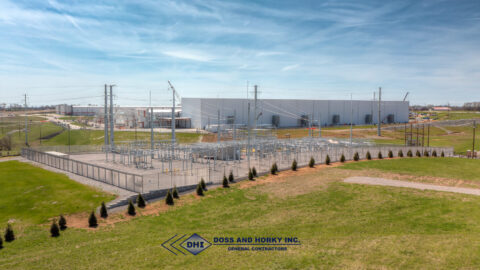
On a substation, duct banks are part of the below-grade work that happens long before anything is energized. They connect yard equipment to the control house and carry circuits out of the substation to the grid.
That work has to be coordinated with site grading, foundations, and the grounding grid. If you want to see how that fits into the bigger picture, read our guide to site preparation for substations. For a broader look at the work utility contractors handle, see What Does a Utility Contractor Do?
Doss and Horky works with Kentucky’s largest utility providers on greenfield substations and upgrades, handling below-grade and above-grade work, duct bank installation, and cable pulling through energization.
Duct bank FAQ
How deep is a duct bank buried? Depth is set by the project design, the utility’s standards, and the electrical codes that apply. Voltage, traffic loads above, and site conditions all affect it.
Why is duct bank concrete red? Red-dyed concrete warns anyone digging later that they have reached electrical infrastructure.
Can you add conduits to a duct bank later? Not without excavating and building new. That is why good designs include spare conduits from day one.
How long does duct bank installation take? It depends on length, depth, soil and rock conditions, groundwater, and the number of conduits. Rock and water add the most time.
Do duct banks need rebar? Only when the design calls for it. Rebar is common where the duct bank crosses roads or sits under heavy loads.
Planning underground electrical work in Kentucky?
Doss and Horky has built critical infrastructure across Kentucky since 1985. From duct banks and cable pulling to full substation construction, our crews deliver below-grade work that is built right the first time.
Contact our team or call 859-236-2690 to talk through your project.